EXCLUSIVE: WeFi Co-Founder Talks Neobanking, A Driving Force For Financial
Inclusivity
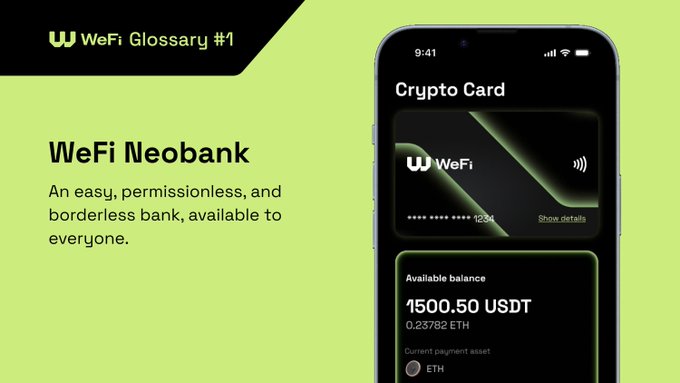
With the many offers and services of banks worldwide, one would think that there are only a few unbanked
individuals, especially as the technological age challenges old practices in the financial
system.However, the World Bank's latest estimates revealed that there are still around 1.4 billion
unbanked people around the world, unveiling the persisting barriers that many people still face even
with the expansion of some of the world's largest banks.Neobanks, digital-only platforms that provide
various services such as online banking, enter the picture with offerings that consumers can access
through their smartphones with lower fees and requiring minimal documentation and verification for basic
services.In an exclusive with International Business Times, digital marketing and blockchain pioneer
Reeve Collins, who is also the co-founder of on-chain neobanking platform WeFi, shared his thoughts on
the rise of the emerging segment and how it has been changing the financial landscape with a focus on
broader inclusivity.Breaking the Barriers for Unbanked ConsumersTraditional banking solutions are known
to come with barriers that prevent many consumers, especially in emerging economies, from engaging with
finance. Among the main hurdles are strict documentation requirements, high fees, and a lack of physical
facilities in remote areas.With neobanks, the entry process is simplified, allowing consumers all around
the world to now be part of the vast financial world. "If you look at the standard KYC (know-your
customer) verification processes within neobanks today, users just need to take a picture of their ID
and a selfie," Collins said."This ease of access empowers unbanked individuals to safely store money,
make transactions, and participate in the broader economy," he added.The Regions That Will Benefit the
Most from NeobankingThere is no doubt many western countries boast of banked populations. However, parts
of Africa, many in Southeast Asia, Latin America, parts of the Middle East, and some areas in eastern
Europe, have yet to indulge in the banking experience.A Statista Research report in 2023 revealed that
in Southeast Asia, many of the unbanked populations were located in Vietnam and the Philippines. In
Africa, Morocco posted the highest numbers of unbanked populations.There is a significant disconnect in
basic financial services in some areas, even in countries where smartphone and internet usage is
incredibly high, such as in Africa."Neobanks can leverage this widespread mobile connectivity to offer
banking services directly through smartphones, bypassing the need for physical branches, making it
easier for consumers to open accounts, transfer money, and access credit," Collins noted.In the Latin
American region where some countries such as Argentina and Venezuela are grappling with inflation and
economic instability, consumers are searching for ways to save on financial transaction fees while
protecting their savings and investing in new financial products that stand as a hedge against
inflation."Neobanks, especially those that integrate cryptocurrencies like we're doing at WeFi, can
provide a secure platform for these needs. They offer an alternative to traditional banking systems that
might not be meeting people's needs effectively," Collins said.The Case of Trust and Other Barriers for
Broader AdoptionThe Statista report underscored how unbanked individuals are generally found in
"countries where citizens have little trust in the banking system." Building trust with consumers is not
an easy task, even for neobanks, especially with persisting cyberattacks on digital platforms.Collins
acknowledged that neobanking service providers will need to convince consumers that their digital-only
platforms are worthy of trust. The way forward is through demonstrating strong security measures and
reliability.He also pointed out how regulatory compliance is a key challenge for neobanks. Traditional
banking is a heavily regulated industry, and rules vary in certain jurisdictions. Navigating through the
regulations can be difficult for neobanks, especially those looking to operate across multiple
regions.Beyond the internal barriers that neobanks may face, there's also the issue on financial
literacy. Older generations may not be comfortable with digital interfaces, and people in areas where
there is limited education on digital services may be hesitant to adopt the new technology. "Without
proper guidance and user-friendly designs, neobanks may struggle to attract these users," Collins
said.What Can Neobanks Do to Trigger a Sure Revolution?Neobanks are already reshaping the financial
realm and doing what traditional banks have struggled to accomplish over the years: catering to the
unbanked. On the other hand, there has yet to be a significant shift. To trigger a revolution similar to
how Bitcoin has changed the game for holders when it first entered the financial space, there are
several measures neobanks may want to consider.For Collins, neobanks should attempt what many firms in
emerging digital finance segments may be struggling with: viewing regulatory compliance with a fresh
approach."Traditional compliance methods can be complex and often create friction for users. Neobanks
should explore new compliance models and next-gen solutions like AI-driven compliance systems that can
streamline processes without sacrificing security. At WeFi, we're exploring how AI can automate
compliance tasks, making them more efficient while enhancing security measures," Collins
revealed.Reaching the unbanked is still a challenge for neobanks, especially people without formal
identification documents. Collins believes neobanking providers should move beyond ID-based verification
and consider behavior-based methods. "By analyzing user behavior and transaction patterns, we can build
secure profiles that allow more people to access banking services without the usual barriers," he
said.Trust is a key gauge for consumers looking into exploring new finance-related offerings. Neobanks
should prioritize security and transparency in this regard, Collins said. Measures include implementing
robust security protocols and being upfront about how user data is handled. Leveraging blockchain
technology can be highly beneficial in this aspect.Finally, neobanks should look into appealing services
that go beyond basic transactions. Neobanking platforms should consider loans, investment options, and
financial educational tools.Neobanks Will Be the NormCollins sees a future where neobanks will no longer
just be an emerging segment but "the norm in digital finances." In the next decade, he is expecting AI
to play a crucial role in driving neobanks forward through smarter budgeting tools, personalized
financial advice, and proactive fraud detection.He also believes accessibility will improve
"dramatically" as neobanking breaks down the barriers for inclusivity by adopting more advanced user
verification methods. "Regulatory landscapes will also adapt," he projected, as governments and
financial authorities begin to collaborate with fintech and blockchain firms.A massive change Collins
expects for the next 10 years is the "full integration of cryptocurrencies and digital assets into
everyday banking." Neobanks will bridge the gap between traditional finance (TradFi) and decentralized
finance (DeFi) as blockchain goes mainstream.WeFi is leading the revolution. It is taking a step further
by integrating blockchain technology into its neobank platform to provide low-cost remittance services.
WeFi also offers digital currency access. Users can hold, transfer or invest in crypto, and in the
future, users may be able to access tokenized real-world assets (RWAs) as well.Amid the evolution, "user
empowerment will be at the forefront," Collins predicted. With neobanks providing the tools that give
people greater control over their finances, the future is bright, especially for the once-unbanked
population.