What Defines A Great City?
Share to Facebook
Share to Twitter
Share to Linkedin
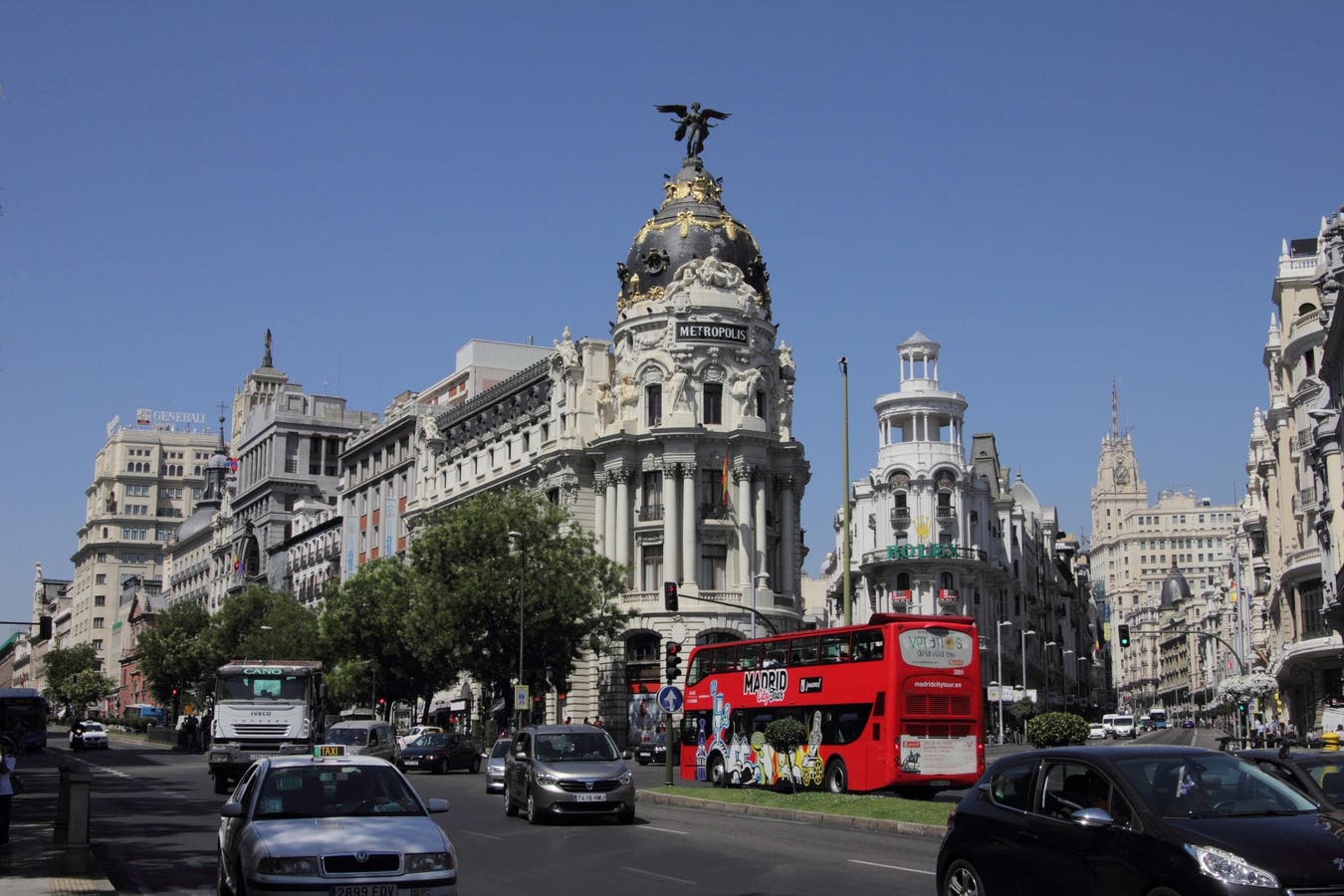
View, across Calle de Alcala, of Edificio Metropolis (or the Metropolis Building), Madrid, Spain, ...
[+] August 6, 2014. (Photo by Dan Porges/Getty Images)
Getty Images
Regular readers will know that I travel a lot, always with a preference for boats and trains and by air
when necessary. Having spent much of the summer without the need for a plane, the next few months will
see an intensification of my travel schedule across Europe, the Middle East and Asia.
In most places I will be talking about the economics and politics of a changing world, but the virtue of
visiting so many cities (Hamburg to Abu Dhabi for instance) and regions (the Cotswolds to South East
Asia) is the opportunity it grants to witness the kinds of growth and development happening in the
world, and the measures we can use to compare economic activity across countries.
Here, a few favourites come to mind. In the 1990’s and early 2000’s it was commonplace for economists
and investment strategists in the large banks to rush back from trips to Asia with tales of how many
cranes they had seen across the skylines of major Chinese cities and estimates of what this meant for
the growth of the Chinese economy. Nowadays, those economists sit on a deck chair in the Marina Bay
Sands hotel in Singapore, look out onto the bay and count the number of tankers anchored there as a
proxy for global supply chain disruption.
Another tell-tale indicator is taxis. A former colleague, friend and reader of this note, with whom I
used to travel to Japan in the late 1990’s referenced the length of taxi queues as a proxy for Japan’s
then moribund economy (often unoccupied taxi ranks would snake around office blocks).
Then on a visit to a thriving Abu Dhabi in 2012, my taxi driver got lost (on the way to the airport). He
apologised, saying it was his ‘first day’. I assumed he meant it was his first day as a taxi driver, but
it turned out that it was his first day in Abu Dhabi. I politely took this as a sign of a vibrant labour
market and a strong economy.
MORE FOR YOU
Why You Missed The Northern Lights Last Night (And How To See Them Next Time)
Northern Lights Forecast: Geomagnetic Storm May Cause Aurora Borealis To Be Visible In These States
Tonight
New Gmail Security Alert For Billions As 7-Day AI Hack Confirmed
A risk that travelling economists face, not unwittingly, is that they normally stay in the centre of a
city, and often in a decent hotel. I wrote a note some time ago describing this as ‘Grande Bretagne’
syndrome, after the teams from the IMF who oversaw the austerity programme of the Greek economy during
the euro-zone financial crisis who stayed in the plush Grande Bretagne and Hilton hotels in the city
centre. While this placed them near the seat of power, it meant that they were blind to the brutal
impact of austerity across the country.
In general, travelling economists should get out and about. For instance, the quality of public
transport in a country is a good indicator of the standard of infrastructure and to an extent, social
cohesion and, is also a good way to observe a society. Someone observed that a city in which the wealthy
use public transport is a well-balanced one (Zurich is a good example). In contrast, there is,
inexplicably, no train from Dublin airport to the city centre, but a ride on the Luas tram will give a
very good idea of the dramatic changes in Irish society.
In keeping with this approach, a favourite activity to beat jetlag and to either reacquaint with or
discover a city is an early morning run (this week’s schedule took in the Tour Eiffel, the Tiergarten
and Madrid (the park was closed due to bad weather)). In that idiosyncratic way, My eyes (and feet) are
sensitive to the quality of the road surface, pollution and to the appearance of new buildings and signs
of dereliction (Berlin scores on both counts).
There are other indicators of the economic prowess of cities, such as the rise of tall towers (the UAE
iShares MSCI UAE Capped ETF
for instance). In this tech driven age, a new category of indicators might comprise cities that want to
become crypto-hubs (UAE, Miami, Zurich, Lisbon) and those that seek to attract large artificial
intelligence (AI) firms (OpenAI has just opened an office in Paris).
As a final note on Madrid, I haven't seen the city as ‘sleek’ or well presented (the 12th was the
national holiday), and it must be said, as expensive. Note that Spain now has a slightly lower interest
rate (bond yield) than France, and a considerably higher rate of growth than Germany.
The economy appears strong, despite concerns that many people versed about the state of Spanish
democracy and its finely balanced political situation – there is likely a contentious budget on the
horizon towards 2025.
There were a lot more Latin Americans than I had expected, and this has both helped tourism, and pushed
up house prices (to the ire of some locals). Spain’s golden visa system means that it is the recipient
of wealthier Latin Americans leaving countries like Venezuela. At the same time, quite a number of
Spanish businesses and executives are relocating to Lisbon, which is a warning sign for innovation.
Follow me on LinkedIn.
Mike O'Sullivan
Editorial Standards
Forbes Accolades