African Potential: The Intersection Of AI, Crypto, And Digital Inclusion
Share to Facebook
Share to Twitter
Share to Linkedin
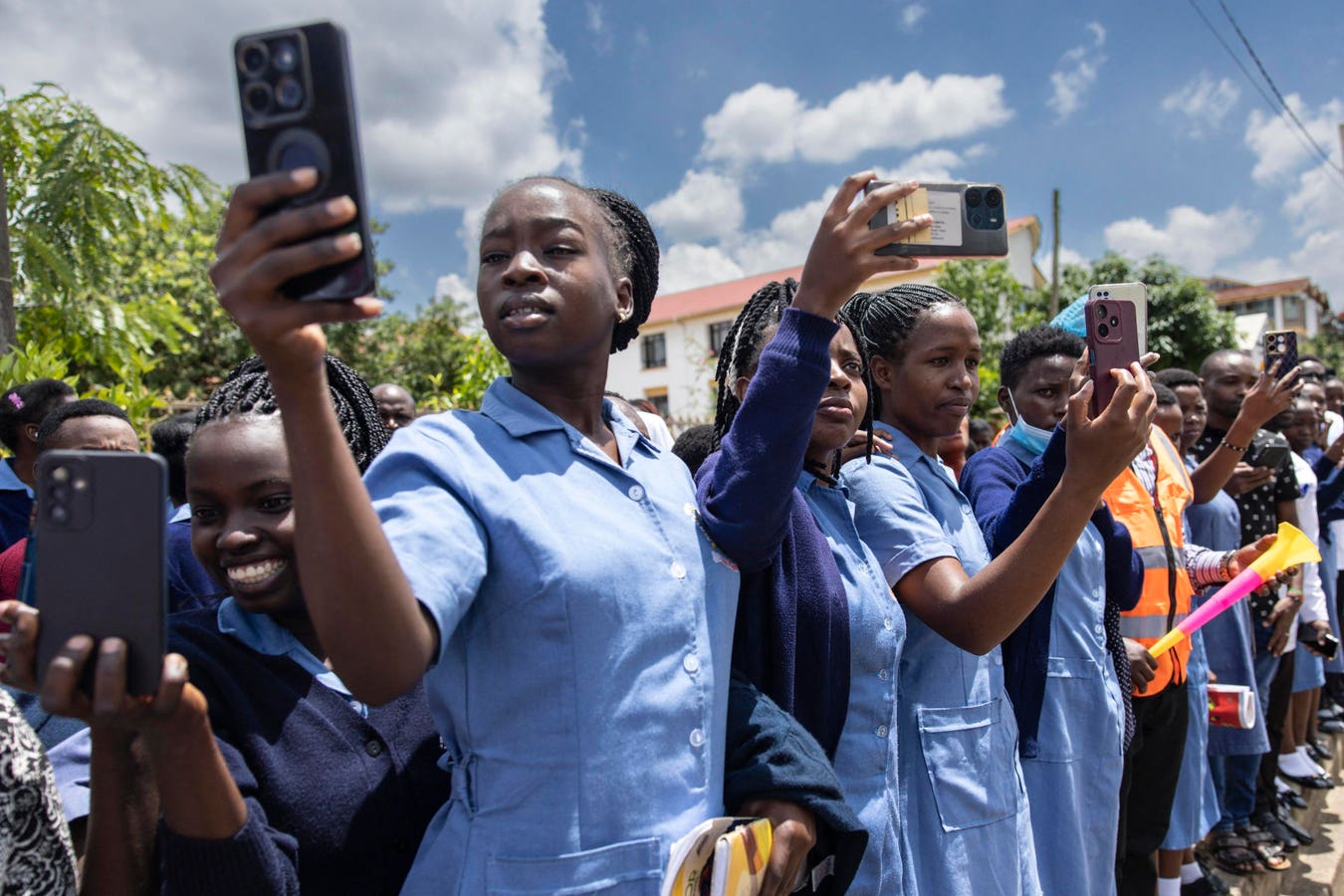
Kenya medical training college students, use their mobile phones to take pictures of doctors ... [+]
chanting as they make their way to the health ministry headquarters protesting with placards to demand
better pay and working conditions in the capital, Nairobi on April 16, 2024. Hundreds of hospital
doctors joined a demonstration in the streets of the Kenyan capital as a nationwide strike by medics
neared its fourth week. (Photo by SIMON MAINA / AFP) (Photo by SIMON MAINA/AFP via Getty Images)
AFP via Getty Images
It’s everything that’s currently wrong with artificial intelligence in a single tweet.
Elizabeth Laraki posted on X/Twitter about a bad experience she had with AI. Elizabeth Laraki is due to
speak at an (unnamed) UX/AI conference later this year, and came across an ad for the event featuring
the photo she’d supplied. Except it wasn’t: the image used in the tweet was subtly different. Whereas
her original photo showed an appropriately-dressed businesswoman, the doctored image showed her shirt
unbuttoned to reveal a suggestive peak of her bra.
Who was this rogue air brusher? Women working in the tech industry won’t be surprised to learn that the
villain, ironically, is artificial intelligence itself. It turns out the organizers had used an AI tool
when cropping and sizing the image, and it had automatically decided to make Elizabeth look far racier
than she’d ever have wanted. What caused the AI to act in such an inappropriate and sexist manner?
Simple: because so much female imagery online is sexualized, AI is trained to think this is how women
should look.
AI Airbrushing Makes Changes
X (Twitter)
Of all the ethical and practical challenges we face in an AI-powered future, this might seem like a
fairly peripheral thing to worry about (although I can assure you, inherent anti-female bias is of
absolutely central importance to every woman). It highlights, however, an issue that affects pretty much
everyone who isn’t a white man from the Global North: inherent biases that ultimately stem from AI’s
representation problem.
The good news is that things are changing fast. Women are increasingly represented at every level of AI
and web3, including as founders and CEOs. So let’s go in search of the next generation of female tech
talent – and what better place to start than in Africa?
Inspirational Women
This week I announced the winners of "Most Inspirational Women in Web3 and AI" at Singularity South
Africa. The 135 winners comprise women who are playing a central role in shaping the future we will all
soon inhabit.
What’s especially encouraging is how many of these inspirational women are occupying the highest
positions, as either CEOs or founders. This indicates that our young industry is making significant
strides towards fair and equal representation – although there’s clearly a long way still to go before
we even approach parity with men.
Since we did the announcement of the the most inspirational list at Singularity South Africa in
Johannesburg, I want to talk about our choice of venue, because that tells another critical story about
the future of representation in AI.
It is summed up here at a high level. "Hosting events that celebrate inspirational women in AI and Web3
in the world but specifically Africa is crucial for fostering innovation and economic growth on the
continent. By promoting diversity in these cutting-edge fields, we can tap into a wider pool of talent
and perspectives, leading to more inclusive and effective technological solutions. Such initiatives not
only inspire the next generation of African tech leaders but also help bridge the gender gap in the
industry, ultimately contributing to Africa's digital transformation and economic development,"
commented Mic Mann, Co-CEO of Singularity South Africa.
Africa Rising
Our decision to unveil this year’s Inspirational Women at Singularity South Africa was a no-brainer. It
is one of the most prestigious tech events in a continent that’s on the cusp of becoming a global
powerhouse of innovation.
With over 60% of Africa's population under the age of 25, the continent is poised to become a major
source of tech talent in the coming years. The World Economic Forum predicts that by 2035 there will be
more young Africans entering the workforce each year than in the rest of the world combined.
Africa, particularly Sub-Saharan Africa, is emerging as a global leader in cryptocurrency adoption and
innovation. The region ranks high on the Global Adoption Index, with Nigeria maintaining its position as
the second-largest crypto market worldwide. Cryptocurrencies, especially stablecoins, are being widely
used for practical purposes such as business payments, hedging against inflation, and facilitating
cross-border transactions.
Digital generated image of hand with dark skin tone going through portal and touching robotic hand. ...
[+] Metaverse and Web3.0 concept.
XYO, a decentralized physical infrastructure network (DePIN), is making significant impacts across the
continent by enabling smartphone users to earn cryptocurrency through data collection. This technology
has led to life-changing earnings for many participants, from paying off mortgages to starting
businesses, with potential to transform entire communities by connecting them to the global data
economy.
XYO's efforts are also addressing data bias by incorporating more African data into global datasets,
contributing to a more comprehensive and human-centric understanding of the world. As Markus Levin,
Co-Founder of XYO, states: "To date there have been 434,998 XYO data nodes all across Africa and
together they earned millions in XYO. I am excited to hear all their individual stories. Africa is at
the heart of XYO's expansion strategy and we see huge potential for the entire DePIN ecosystem."
Markus Levin, Co-Founder of XYO
Sub-Saharan Africa leads the world in DeFi adoption, driven by the need for accessible financial
services in a region where traditional banking is limited. Stablecoins have become crucial in countries
facing foreign exchange crises and currency volatility, accounting for about 43% of the region's total
transaction volume.
Africa's real-world crypto use cases offer valuable lessons for the global market, positioning the
continent as a potential future leader in crypto innovation and financial inclusion.
Africa’s tech sector is often written off or, worse, ignored. That’s a massive, myopic mistake. Sure,
the continent faces several significant challenges, not least with its relatively underdeveloped digital
infrastructure. Yet, what it might lack in connectivity, it more than makes up for in talent and
ingenuity (a fact reflected in the number of African winners and nominees in this year’s Inspirational
Women). Africa has a thriving AI industry, with developers applying the technology in incredibly
creative, groundbreaking ways to solve specific local challenges – with healthcare a particular focus.
I can’t do much more than scratch the surface of Africa’s burgeoning AI sector, but I’m particularly
excited about projects that use the technology to make drugs and vaccines better tailored and more
effective for local people. To take just one example, Ocular is an app that uses a 3D-printed adapter
that connects a smartphone camera to a microscope, and uses predictive AI to judge if cervical lesions
are cancerous. It’s the perfect example of an African solution to an African challenge, and which works
with existing technology and infrastructure.
That’s not to say Africa’s AI solutions are only locally relevant; in fact, these countries face many
challenges with the rest of the Global South, so there’s huge potential for AI to become one of the
continent’s most lucrative exports. Little wonder that a recent report from Google estimates that
artificial intelligence (AI) could contribute over $30 billion to sub-Saharan Africa’s economy in the
coming years.
No Representation without Education
None of this is to deny that Africa faces significant obstacles on its journey to become a global hub
for AI. I’ve already touched on the infrastructure challenges, and these are not easily overcome.
Internet access across sub-Saharan Africa is patchy to say the least: while around two thirds of people
in southern Africa are online, that falls to only 24% in Central Africa, while the figure for West
Africa is around 30%.
Connectivity is critical for the success of AI, and not just for the functioning of AI agents and
services. If we are to develop truly representative AI, we need to reach those who, by definition, have
traditionally been locked out from previous digital revolutions. That’s why the next frontier for AI is
education, which is why we’re seeing huge investment in initiatives to foster the next generation of
(especially female!) talent across Africa.
Groups like Data Science Nigeria, Data Science Africa, and South Africa’s Deep Learning Indaba do
tremendous work in organizing conferences and training events, providing research grants for local AI
projects, and awarding mentorships, grants and awards. I’m proud to say that Unstoppable Women of AI /
Web3 – the organization I founded and which is behind Inspirational Women – is also playing its part,
with our commitment to provide Web3 and Metaverse education to six million women in Africa over the next
five years.
This is just the beginning of a long journey to eliminate dangerous biases from AI and make sure it
brings equal benefits to everyone, regardless of their sex, race, nationality, sexuality, or any other
characteristic. Yet when I look at Africa’s burgeoning AI sector, or at our Inspirational Women winners,
I know we’re going in the right direction.
Elizabeth Laraki’s story is just one, relatively minor example of what happens when a whole group of
people are sidelined by AI. That’s what representation means to me: it’s not just a tick-box exercise
that gives equity, diversity and inclusion (EDI) practitioners something to justify their exorbitant
salaries. For women, for Africans, and for many other marginalized groups, it’s about making sure our
outlooks, opinions, experiences, and, of course, leadership are at the forefront of the most momentous
technological and societal revolution in our lifetimes.
Follow me on Twitter or LinkedIn.
Sandy Carter
Editorial Standards
Forbes Accolades