Central Banks Are Increasingly Studying Bitcoin
Share to Facebook
Share to Twitter
Share to Linkedin
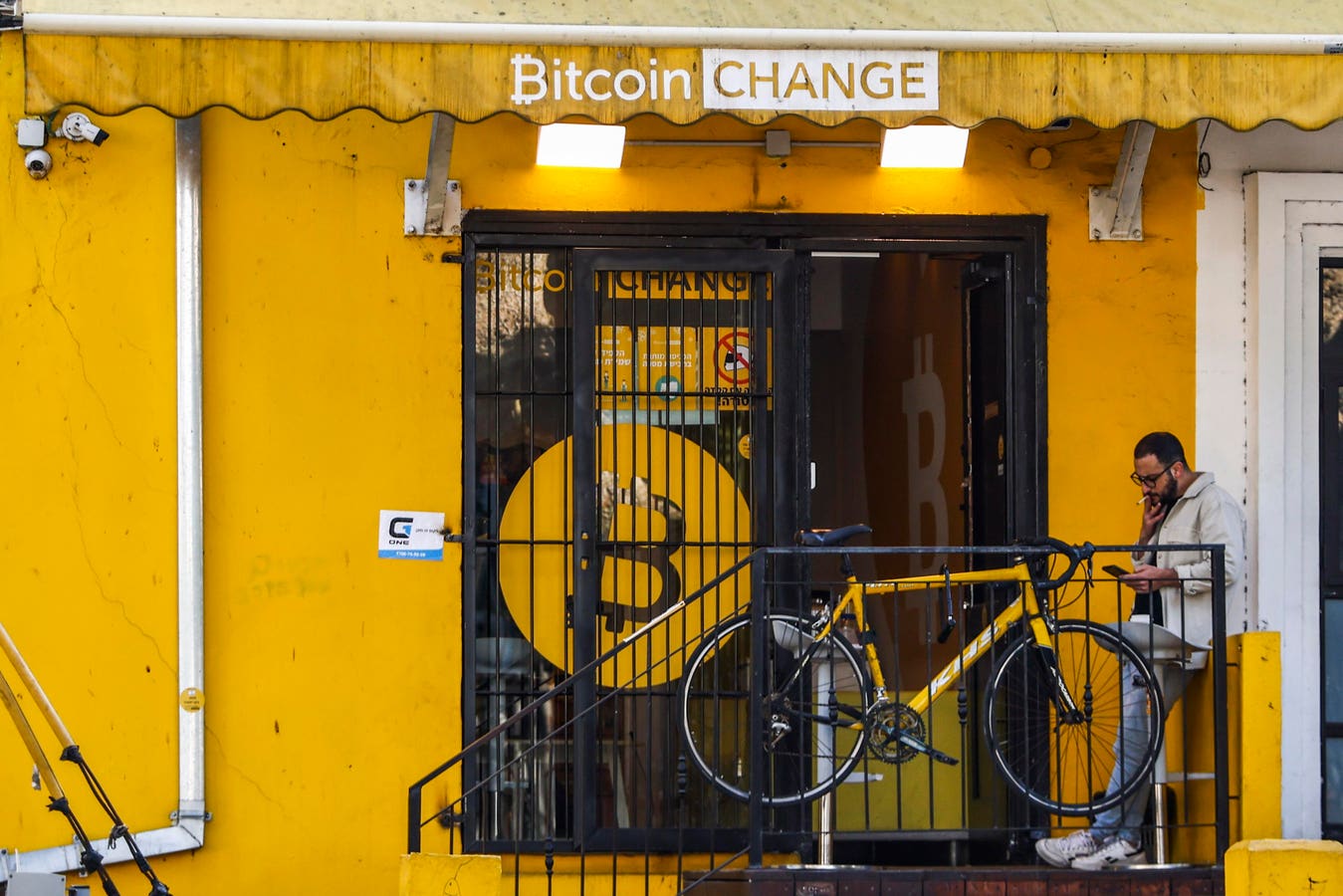
Bitcoin change store in Tel Aviv, Israel on December 30, 2022. (Photo by Beata Zawrzel/NurPhoto via ...
[+] Getty Images)
NurPhoto via Getty Images
In recent years, a growing body of research has emerged from central banks and financial institutions,
focusing on Bitcoin and its potential impact on monetary policy. These studies, issued by organizations
such as the Minneapolis Federal Reserve, the European Central Bank (ECB), and the International Monetary
Fund (IMF), highlight a key theme: the disruptive nature of Bitcoin and other cryptocurrencies could
limit the ability of central banks to perform their traditional role in managing economies. Advocates
have argued that Bitcoin could be an alternative to central banking, are central banks finally
recognizing Bitcoin as a potential threat?
Can Bitcoin Lead To Inequality?
The European Central Bank’s researchers have published two papers on Bitcoin, both of which offer
strikingly different perspectives. The first, published in the wake of the FTX collapse in 2022 while
Bitcoin was trading at $16,000 - titled “Bitcoin’s Last Stand” - portrays Bitcoin as being a failed
monetary experiment in its final death throes. In 2024, with Bitcoin trading at nearly $70,000, the same
authors at the European Central Bank published a paper acknowledging a different reality.
This latter paper argues that Bitcoin’s existence and continued appreciation has a significant impact on
wealth distribution. According to the paper, when Bitcoin's price rises, early Bitcoin holders get
wealthier. However, since Bitcoin doesn't produce anything or increase economic output, this increased
wealth and consumption by early holders must come directly from reduced consumption by everyone else in
society.This means that when early Bitcoin holders spend their profits on goods and services, they are
using purchasing power that has been taken from non-holders and people who bought Bitcoin later. This
reduction in people’s purchasing power happens even if Bitcoin's price keeps going up forever and even
impacts individuals who don’t buy Bitcoin at all.
The key insight is that Bitcoin wealth doesn't create new economic value - it just redistributes
existing wealth. Even in the most optimistic scenario where Bitcoin's price keeps rising, it makes early
holders richer only by making everyone else poorer in relative terms. The authors argue this is
different from gains in stocks or property values, which can reflect and contribute to actual increases
in economic productivity and output. With Bitcoin, the gains are purely redistributive since Bitcoin
itself doesn't produce anything or increase economic capacity.
This ECB viewpoint mirrors a longstanding critique made by Bitcoin proponents regarding central banks.
The Cantillon effect, named after 18th-century economist Richard Cantillon, suggests that central banks,
by printing money, disproportionately enrich those who are closest to the money supply (such as banks
and wealthy individuals), while the rest of the population sees diminished purchasing power. When new
money enters the economy, it doesn't affect all prices simultaneously - instead, the first recipients of
the new money (typically financial institutions) can spend it before prices rise, while those furthest
from the money supply (typically ordinary citizens) only experience the resulting inflation.
MORE FOR YOU
Tesla Billionaire Elon Musk Declares ‘Financial Emergency’ As $35.7 Trillion ‘Debt Bomb’ Primes A
Bitcoin Price Boom To Rival Gold
Trump Vs. Harris 2024 Polls: Harris Leads In Latest 2 Surveys—As Most Polls Show Razor-Thin Race
iPhone 17 Pro Max Design Upgrade: New Look Predicted In Latest Leak
The redistributive properties of monetary policy have been widely documented and debated. Central banks
themselves have investigated whether quantitative easing - where central banks purchase financial assets
to boost the economy - has increased wealth inequality. By purchasing assets like government bonds and
mortgage-backed securities, quantitative easing tends to drive up asset prices, benefiting those who
already own such assets. This creates a similar redistributive effect to what the ECB criticizes in
Bitcoin: wealth is transferred from one group to another without necessarily creating new economic
value.
Can Bitcoin Jeopardize Monetary Policy ?
A recent working paper from the Minneapolis Fed looks at Bitcoin from a different angle. The paper
argues that when people can freely buy and hold Bitcoin (or similar "useless pieces of paper"), it
becomes harder for the government to run consistent budget deficits. Normally, the government can spend
more than it takes in through taxes by selling government bonds. For this to work, these bonds need to
stay valuable. But when Bitcoin exists as an alternative, something tricky happens - no matter what
smooth, predictable policies the government tries to use, the government might get forced into a
situation where it has to spend only what it collects in taxes. The researchers found only two ways to
fix this problem: either completely ban Bitcoin, or put a specific tax on owning it. It's worth noting
that this isn't about Bitcoin's price or how many people use it - just its mere existence as something
people can buy creates these complications for government deficit spending.
The Minneapolis Fed is not the only institution concerned about the ability of Bitcoin to hamper the
effectiveness of monetary policy. The IMF’s 2023 policy paper focused on how cryptoassets could weaken
monetary policy effectiveness, particularly in emerging markets with unstable currencies and weak
monetary frameworks. While skeptical of implementing blanket bans on Bitcoin and other cryptocurrencies,
countries should focus first on strengthening their monetary policy frameworks and institutions. The
paper suggests that currency substitution ("cryptoization") is more likely to occur with stablecoins
pegged to foreign currencies, as they offer a less volatile alternative to domestic currency, rather
than with volatile cryptocurrencies like Bitcoin.
The paper specifically recommends against granting crypto assets legal tender status, as this would
further weaken monetary sovereignty. Instead of anti-crypto programs, the IMF advocates for
comprehensive regulation alongside robust macroeconomic policies. The key to protecting monetary policy
effectiveness, according to the IMF, is maintaining credible institutions and sound monetary frameworks
- addressing the root causes that might make citizens want to switch to crypto in the first place. This
approach reflects the IMF's current view that while crypto poses risks to monetary policy transmission,
the solution lies in strengthening traditional monetary and fiscal frameworks rather than focusing
primarily on crypto restrictions.
Central Bankers Are Taking Bitcoin More Seriously
The research from central banks and the IMF shows that monetary policymakers are taking Bitcoin far more
seriously than before. Working papers do not necessarily mirror the thinking of decision makers at
central banks, but are nonetheless an indication of how monetary policy is increasingly taking Bitcoin
seriously. This goes beyond academic working papers and is also reflected in policy: the IMF’s 2022
Argentina bailout included several anti-crypto provisions.
The European Central Bank’s arguments against Bitcoin warrant some introspection from central bankers
themselves. If Bitcoin's redistributive effects are problematic because they transfer purchasing power
from latecomers to early adopters, how is this fundamentally different from monetary policy that
transfers purchasing power from those far from the money supply to those closest to it? Both mechanisms
seem to create winners and losers through the redistribution of purchasing power rather than through
productive economic activity. In any case, it shouldn’t come as a surprise to central bankers if
Bitcoin’s increased adoption becomes an obstacle to the ability of central banks to dictate monetary
policy. This has been a long standing goal of Bitcoin enthusiasts. From its inception Bitcoin’s
self-professed goal has been to provide an alternative to centrally planned monetary policy.
Follow me on Twitter or LinkedIn. Check out my website.
Boaz Sobrado
Editorial Standards
Forbes Accolades