Bitcoin Exempt From Capital Gains? Bitcoin Becomes “Money” In U.S.
Share to Facebook
Share to Twitter
Share to Linkedin
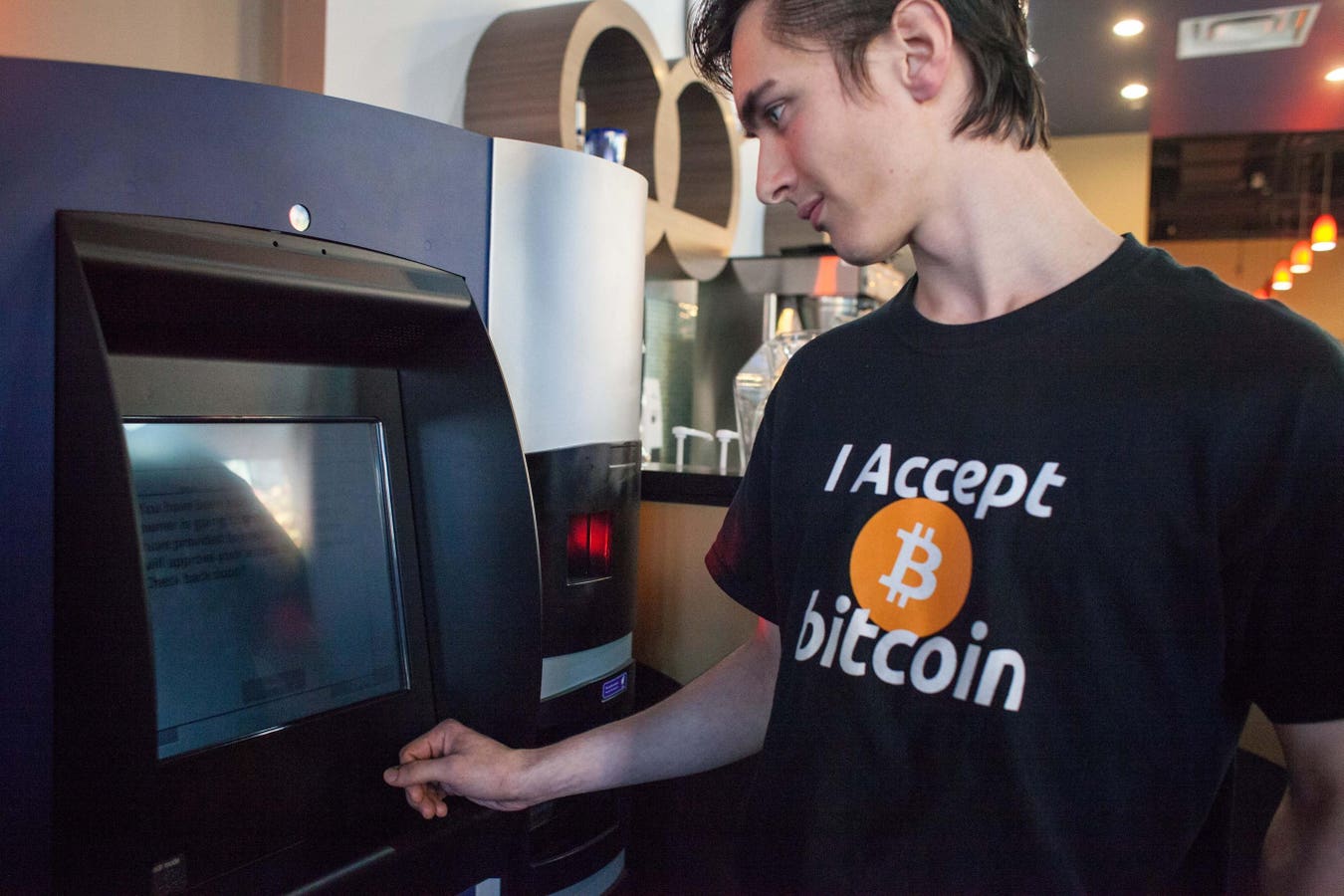
A man uses a bitcoin ATM.
Getty Images
In a recent post on X, Microstrategy CEO Michael Saylor posted a quote from a recent interview with
Donald Trump where he discussed his evolving views on bitcoin. In this short answer, Trump made several
statements that are significant for the possibility of bitcoin becoming deeply intertwined in the U.S.
economy in the coming years.
"They have them paying tax on crypto and I don't think that's right. #Bitcoin is money and you have to
pay capital gains tax if you use it to buy a coffee? I was talking with a friend he said 'it really
shouldn't be taxed' and I agree.”
The idea of eliminating capital gains tax on bitcoin is not new – it has had bipartisan supporters in
the U.S. Senate for years – but we are at a critical moment today when a confluence of political
circumstances could ignite bitcoin adoption in the U.S., and by proxy, worldwide, to an unprecedented
degree.
With the increasingly likely outcome of a Trump victory, his statements about bitcoin are consequential
for the way bitcoin might be regulated and taxed in the coming years. His use of the phrase “bitcoin is
money” is key for understanding why. To do that, it’s helpful to review Trump’s past statements about
bitcoin and crypto so that we can trace the path that led to this view.
MORE FOR YOU
Samsung’s Impossible Deadline—You Have 24 Hours To Update Your Phone
Harris And Trump’s Biggest Celebrity Endorsements: Cardi B To Stump For Harris In Wisconsin Friday
New Windows Warning As Hacker Breaks Google Chrome 2FA Security Encryption
Bitcoin’s Threat To The Dollar
The evolution in Trump’s thinking about bitcoin will be familiar to many people who followed a similar
journey as they studied bitcoin.
Because it is an emerging technology that deviates from the accepted wisdom about what money is, on
first encountering bitcoin, most rational people will resist it and assume it is probably nonsense.
Along these lines, Trump stated during his previous administration that “bitcoin... [is] not money.” He
rightly intuited that in the 21st century, U.S. power is derived principally from the dollar’s roles as
the leading world reserve currency, a store of value for central banks and institutions, and medium of
exchange for oil and other commodities.
Insofar as he understood that bitcoin threatens this favorable arrangement, he believed that bitcoin
cuts against his vision for increasing American leverage in foreign policy. The ability of the U.S. to
print money and decide who gets it is indeed the most extraordinary power ever obtained by a single
political body in human history.
Our open capital markets seal the deal, allowing the U.S. economy to benefit from investment in those
dollars back into our financial system. This lets the federal government collect taxes on the productive
capital of the entire planet. One does not simply give that up, and it would be rational to suppress new
technologies that threaten change.
Revisiting Free Market Principles
A few months ago, during his 2024 campaign for president, Trump changed his stance. When asked a
question about whether he supports access to crypto, he replied that he’s “fine with it.”
He didn’t offer justification as to why his attitude changed, but it would be reasonable to assume that
politics had a strong influence.
The Biden/Harris administration is inextricably linked to the rise and fall of FTX, which turned out to
be a money laundering operation that benefitted U.S. politicians – which is likely why regulators
allowed it to operate for so long. The current administration is also implicated in the corrupt and
possibly illegal attacks on banking institutions, dubbed Operation Chokepoint 2.0. A leading Democratic
senator has attempted to build an “Anti-Crypto Army,” using militaristic language to threaten a $2.33
trillion industry. A deeply unpopular SEC chair, Gary Gensler, has intimidated and undermined leading
financial innovators.
It is estimated that 26% of Americans own bitcoin – and that doesn’t include financial products like
spot bitcoin ETFs. Being “fine with it” is just good politics. Trump’s comments were widely praised by
the bitcoin and crypto communities, and laid groundwork for Trump giving a historic keynote speech at
the Bitcoin Conference in the summer of 2024.
Dalliance With DeFi And World Liberty Financial (WLFI)
Along a typical person’s journey to understanding bitcoin, one arrives at a fork in the road. One path
is to recognize the uniqueness of bitcoin; the other is to assume that the technologies that underlie
bitcoin are the real innovation, and that new tokens, tools, DeFi platforms, and crypto projects are
more important.
Taking the crypto path, Trump (and his sons) conceived and promoted a dubious DeFi product called World
Liberty Financial. After a launch that could be characterized as somewhere between disappointing and
disastrous, we haven’t heard much about it. The less said about that, the better.
Separation Of Money And State
Crypto projects like World Liberty Financial and other DeFi and NFT initiatives miss the forest for the
trees.
There may eventually be use cases for crypto that lead to healthy businesses with staying power. But,
the real prize that Satoshi’s invention makes attainable is something far more profound: separation of
money and state.
Over the past decade, a movement has arisen that heavily overlaps with Trump’s base of supporters (but
extends beyond it) to reexamine the costs and benefits of the staid institutions established in the
early to mid 20th century. Which ones do we need? Which ones have been corrupted? What alternatives do
we have?
The Federal Reserve is a prime example. Its original mandate was to defend the value of the dollar.
Since it was created in 1913, the dollar has lost 97% of its purchasing power.
In recent years, the naive belief that most Americans had – that the Fed is an apolitical body of
benevolent technocrats who would never use their immense, ring-of-Sauron-like power for anything but the
good of humanity – has evaporated. As the followers of Donald Trump, Robert F. Kennedy, Jr., Ron Paul,
Bernie Sanders, Tulsi Gabbard, and others have woken up to this reality, previously held assumptions
about the very nature of money are being reexamined.
Does money really need to be issued by a central authority? Why should the price of money be dictated by
the Fed, instead of the market? Is it strange that a single man or woman can walk up to a podium, give a
5 minute speech, and impact the prosperity of 8 billion people across the entire planet? WTF happened in
1971? (For those not familiar – 1971 was the year that the Nixon administration eliminated the last
vestiges of the dollar’s tie to a scarce asset, unleashing the money printer to be used at will.)
Bitcoin Is Money
This brings us to present day, when the U.S. government treats bitcoin in a confused, inconsistent
manner. Multiple sclerotic bureaucracies are competing to extend their mandate to include regulation of
bitcoin. The Commodity Futures Trading Commission (CFTC) would like it to be classified as a digital
commodity so that it falls under their purview. SEC chairman Gary Gensler, who once asserted that
bitcoin is a commodity, now refuses to do so, presumably for fear of losing his ability to regulate it.
He has avoided issuing proactive regulatory guidance to the bitcoin industry, choosing instead to
regulate by enforcement. Meanwhile, leading politicians and their media mouthpieces have stated that it
is a tool for criminality and nothing more.
Taking a step back to compare bitcoin to other forms of money, it is clear that it fits the definition,
and for good reason – it has qualities that make it useful to fulfill the role of facilitating value
exchange in a global, digital economy.
Bitcoin compared to other forms of money, from "Bitcoin Foundations." Adapted from The Bullish Case ...
[+] for Bitcoin by Vijay Boyapati and other sources.
Bitcoin Foundations
Ultimately, this is why Trump’s statement is so consequential.
Eliminating capital gains tax on bitcoin transactions would reduce filing complexity for bitcoin users,
as well as their tax burden. But it is giving bitcoin the label of “money” that changes everything and
sets the stage for it to be used in everyday commerce.
If the status of bitcoin in the U.S. is clarified to be money from a regulatory perspective, we can
expect a boom in the development of wallet software, e-commerce and retail payments solutions, private
transactions, and more.
In the medium term, bitcoin may even save the U.S. from its over-reliance on the power of its money
printer, which has caused political and market distortions that are no longer tolerable by a large swath
of American voters and international interests.
The dollar has been mortally wounded by a collapse in trust of American institutions. It can be kept on
life support for a time, perhaps even decades. But it will never return to the status it once had.
Bitcoin enables decentralized value exchange with final settlement. Accelerated adoption in the coming
years would converge with the rise of AI and nuclear power, two complementary emerging technologies for
which bitcoin solves impediments to growth.
It is hard to imagine a more consequential policy decision in the coming administration. Here’s hoping
that the designation of bitcoin as money comes to fruition.
Follow me on Twitter or LinkedIn. Check out my website.
Dave Birnbaum
Editorial Standards
Forbes Accolades