AI Meets DeFi For New Financial Intelligence From The USA To Dubai
Share to Facebook
Share to Twitter
Share to Linkedin
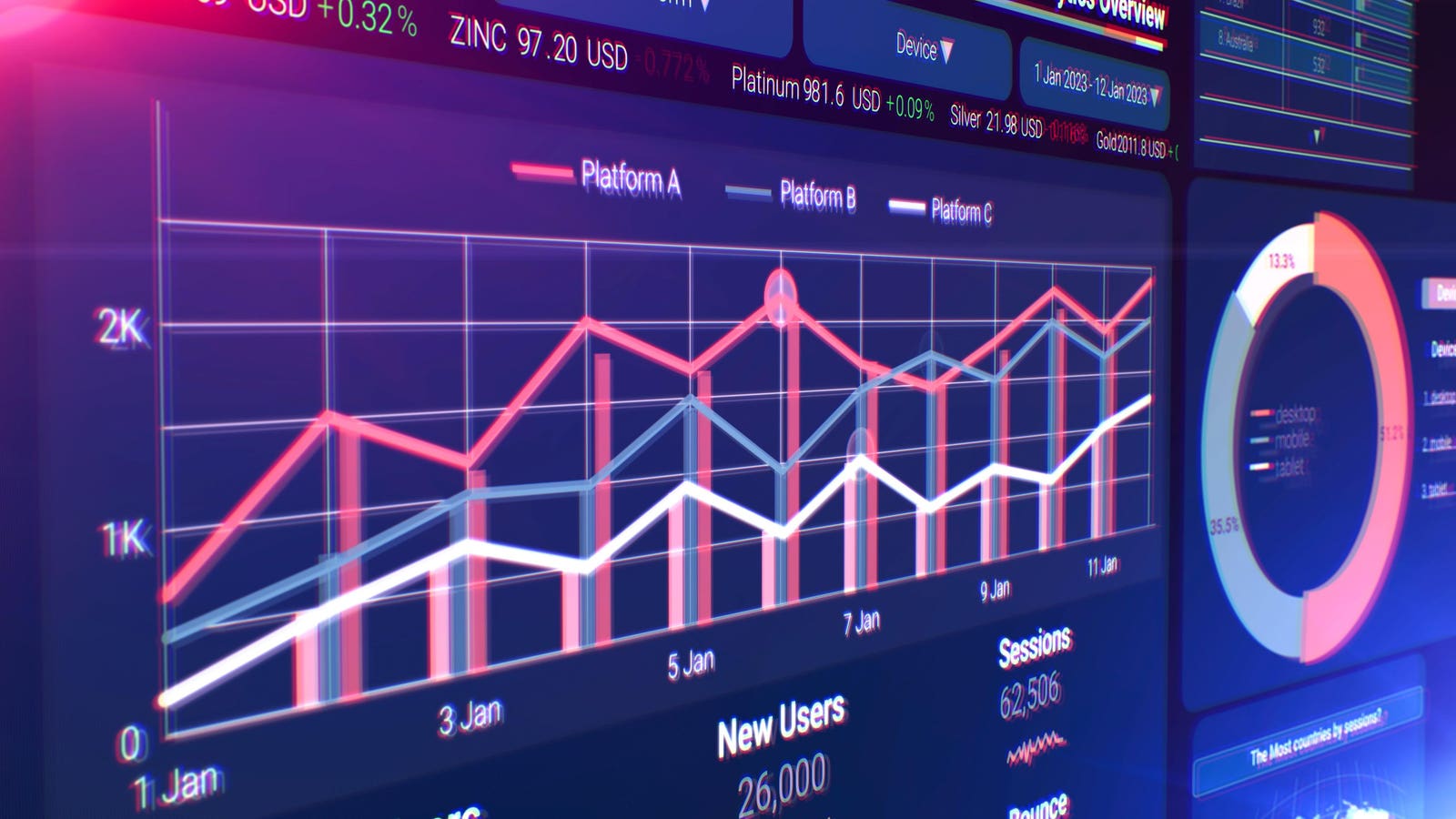
Business data Analytics and financial dashboard abstract background
In a world where bytes meet banking, Artificial Intelligence (AI) isn't just meeting Decentralized
Finance (DeFi)—it's creating a financial force multiplier that's DeFi-ning the future. As traditional
finance plays catch-up, this AI-powered DeFi revolution is computing compound interest in ways Wall
Street never imagined.
From my vantage point traveling in Dubai—a city transforming from desert dunes to digital dominance—I'm
witnessing the convergence of these technological titans firsthand. The Emirates' crystal-clear
regulatory framework has turned its silicon sands into a fertile oasis for innovation, where both AI
startups and blockchain behemoths are coding the next chapter of financial evolution. Here, among the
world's tallest skyscrapers, the highest aspirations of digital finance are taking root, proving that
when AI meets DeFi, the sky isn't the limit—it's just the beginning.
During my recent visit to Dubai for Domain Days, I witnessed the city's remarkable leadership in both AI
and blockchain technologies. In a conversation with Dr. Marwan Alzarouni, CEO of the Dubai Blockchain
Center, he observed, "Dubai represents something unprecedented: a city that's simultaneously an AI
accelerator and a DeFi incubator. The confluence of clear regulations, technological infrastructure, and
visionary leadership has created a perfect storm for financial innovation. It's not just participating
in the future of finance—it's actively architecting it."
Dr. Marwan Alzarouni, CEO of the Dubai Blockchain Center
Sandy Carter
According to a report by Market Research Future, the AI in fintech market was valued at USD 9.6 billion
in 2022 and is projected to grow to USD 39.1 billion by 2032, exhibiting a compound annual growth rate
(CAGR) of 16.90% during the forecast period (2023–2032). Meanwhile, DeFi has surged, with the total
value locked (TVL) peaking at over $200 billion in 2022, as reported by DeFi Pulse. This was the year AI
went from curiosity to near-ubiquity; in 2023, McKinsey found that AI adoption did not reach 66 percent
in any region; in 2024, more than two-thirds of respondents in nearly every region say their
organizations use AI.
MORE FOR YOU
Today’s NYT Mini Crossword Answers For Friday, November 8
Federal Judge Strikes Down Biden Program Offering Legal Status To Undocumented Spouses Of U.S. Citizens
Can Trump Fire Jerome Powell? Fed Chairman Says He Won’t Resign If Trump Asks
Trump’s symbolic purchase of a hamburger with crypto is more than just a novelty—it signals how crypto
is integrating into everyday American life and underscores its growing legitimacy as a mainstream
payment option. In the evolving landscape of DeFi and AI, cryptocurrency serves as the foundational
layer, facilitating seamless, decentralized transactions and enabling instant, cross-border payments
without intermediaries. As AI tools enhance crypto's security and usability, they’re further integrating
digital assets into day-to-day transactions, making crypto a viable currency rather than just an
investment vehicle.
DEFI concept. 3D render
In the U.S., crypto’s utility in DeFi is especially pronounced, where it acts as the medium for lending,
borrowing, and earning yield on decentralized platforms. Crypto’s blend with AI is also enhancing
anti-fraud measures, refining predictive analytics for financial services, and even enabling smarter,
more personalized financial products. Crypto is poised to push further into the mainstream,
strengthening the DeFi and AI ecosystems as powerful alternatives to traditional finance. Together,
they’re building a new financial paradigm where buying a hamburger—or investing in new financial
products—can be done effortlessly through digital assets.
The future of finance seems sunny, but there are some clouds gathering on the horizon, however. While
not yet posing an existential risk, it’s important to recognize the emerging challenges that stand in
the way of full AI-DeFi integration.
The Dark Side of AI-DeFi Integration
Before diving into the innovations, we must address the elephant in the room. Critics raise alarming
concerns about the combination of AI and DeFi creating a "financial skynet" scenario. When autonomous AI
agents control billions in digital assets, who's truly accountable when things go wrong?
The October 2023 Flash Crash, reported by CoinDesk, where an AI trading bot malfunctioned on the Binance
perpetual futures market caused a $40M loss in under 3 minutes, serves as a sobering warning.
Furthermore, there's growing evidence that AI-powered DeFi platforms might be inadvertently creating new
forms of financial inequality – where those with access to the best AI models consistently outperform
regular retail investors.
Not only would this be a betrayal of the AI revolution; it also undermines the incredible innovations
we’re beginning to see emerge in this space. With this in mind, let’s take a look at some of the most
exciting AI-DeFi applications, celebrate their potential – but be unafraid to identify the challenges on
the road ahead.
Leading Companies at the intersection of AI-DeFi
While I was recently in Africa, I had the pleasure of speaking to Evan Luthra, General Partner, KOL
Capital, about AI-DeFi. He told me, “The intersection of AI and DeFi is not just transformative—it’s
revolutionary. We’re on the brink of a financial renaissance where decentralized systems and AI
algorithms work in tandem to bring power directly to the people. This shift will break down traditional
barriers, enabling global, frictionless access to wealth-building opportunities previously reserved for
a select few. In the near future, everyone, regardless of geography or background, will have the tools
to manage, grow, and protect their financial futures with unprecedented precision and autonomy. This is
the new world of finance, and it’s only just beginning.”
Evan Luthra, General Partner, KOL Partner
Evan Luthra
Here are some of the top companies in this space.
1. Numerai: Crowdsourced Investment Intelligence. Numerai is making waves in the hedge fund space by
using AI to crowdsource financial data predictions. While revolutionary, some economists warn this model
could create dangerous feedback loops in market behavior, potentially amplifying rather than predicting
market movements.
2. Alethea AI: From NFTs to Smart Financial Contracts. Alethea AI is widely known for its pioneering
work in creating interactive and intelligent NFTs. But its AI capabilities go beyond digital art.
Imagine a DeFi world where smart contracts don't just execute code but adapt, respond, and make
decisions based on real-time data. Alethea AI's technology could be a game-changer for DeFi platforms
looking to enhance user engagement and create intelligent, self-adjusting financial contracts.
3. Fetch.ai: Autonomous Agents for Financial Automation. Fetch.ai merges blockchain and AI to deploy
autonomous agents that execute complex financial and data-sharing tasks. For DeFi, this means a world
where market-making and smart contract operations run seamlessly without human intervention. These AI
agents analyze market conditions, optimize trading strategies, and even negotiate asset trades—all in
real-time. Fetch.ai's ecosystem illustrates how AI-driven automation can take decentralized finance to
the next level of sophistication.
Robotic process automation RPA Document management system DMS for company digital transformation ... [+]
paperless workflow, better data search store share and security cloud technology. futuristic 3D robot
4. SingularityDAO: The Powerhouse for DeFi Portfolios. A subsidiary of SingularityNET, SingularityDAO
leverages AI to manage and optimize DeFi portfolios. At its heart is the concept of DynaSets –
dynamically managed assets that are automatically rebalanced by AI-based signals and algorithms. Their
AI-driven tools continue to predict market movements, automate trading, and enhance yield strategies.
5. Autonio Foundation: Democratizing Algorithmic Trading. Autonio Foundation is on a mission to make
algorithmic trading more accessible to everyday users. By developing AI-powered trading tools and
analytics, Autonio equips traders to compete in the high-speed world of DeFi. Its solutions improve
liquidity, enable strategic trading, and harness machine learning for better market insights. This
democratization of AI-driven trading shows how powerful tech, once reserved for financial giants, is
becoming available to a wider audience.
Why Some Argue AI Could Do This Without Blockchain
While the integration of AI and blockchain is seen as a powerful combination, some experts argue that AI
could achieve many of the same benefits without blockchain. AI's ability to process vast amounts of
data, optimize decision-making, and automate complex processes stands on its own. Critics point out that
blockchain's decentralization, while valuable for trust and transparency, can introduce inefficiencies
and slower transaction speeds.
They suggest that centralized systems enhanced by AI could provide similar levels of innovation,
security, and efficiency without the added complexity of blockchain technology. This debate underscores
the tension between the modern trend towards decentralization, and AI’s voracious, all-consuming
appetite for data and computing power. The question is whether blockchain is essential, or simply a
complementary layer in AI-driven financial solutions.
What's Next for AI in DeFi?
The convergence of AI and DeFi is still in its early stages, but the implications are massive. Companies
like Numerai, Alethea AI, Fetch.ai, SingularityDAO, and Autonio Foundation are proving that the
potential of these technologies is far from theoretical. They are building solutions that aren't just
futuristic—they're functional, present, and poised to reshape finance as we know it.
The future of DeFi is one that's smart, automated, and inclusive, thanks to the transformative power of
AI. However, as we've seen with recent flash crashes and emerging controversies, this future also comes
with significant risks that need to be carefully managed and regulated. Technological revolutions will
always have their enemies; right now, what the emerging and converging AI and DeFi industries need is
some honest and critical friends to ensure they stay on the right track, swerve potential risks, and
ensure they bring benefits equally and to all.
Follow me on Twitter or LinkedIn.
Sandy Carter
Editorial Standards
Forbes Accolades