Why is Trump’s election as US president prompting a Bitcoin surge?
Bitcoin surged to a record high of $89,000 on Tuesday as investors pumped money into cryptocurrencies
following the election of Donald Trump as United States president, who has turned from a cypto-sceptic
to an investor himself.
Bitcoin, the oldest and the largest crypto currency, has seen its value go up by 30 percent in the past
week. It is not the only cryptocurrency on the move. Since Trump’s victory, Dogecoin — a currency backed
by Trump ally Elon Musk — has surged 152 percent.
Cryptocurrency is a “digital alternative” to traditional money and works online without a central
authority. But it has long also been very volatile and has faced government curbs in several parts of
the world.
So how is the crypto spike linked to Trump’s election and will the new US administration ease regulatory
frameworks around crypto?
What explains the crypto surge since Trump’s win?
Analysts believe Trump’s embrace of cryptocurrencies during the presidential campaign and his venture
into crypto trade is luring investors on the expectation that the new administration would be
crypto-friendly.
The Trump campaign accepted donations in cryptocurrency and he also appeared at industry events,
promising to make the US “the crypto capital of the planet”.
In late September, Trump and his three sons – Donald Jr, Eric, and Barron – unveiled his latest
entrepreneurial endeavour, World Liberty Financial. Billed as a decentralised finance (DeFi) money
market platform, this new venture introduced a proprietary cryptocurrency dubbed $WLFI.
Although details of the new venture are unclear, many pro-crypto enthusiasts see this as a nod of
support for digital currencies from the incoming Trump administration.
The venture has drawn criticism from some experts in the DeFi sector for possible conflicts of interest
and the fact that the venture was launched during the 2024 presidential campaign.
In a recent interview with Newsweek magazine, Michael Dowling, professor of finance at the Dublin City
University Business School, stated: “There have been such a parade of undesirables in the crypto and
DeFi world that adding Trump to the list couldn’t possibly push the needle on popularity or enthusiasm.
Bear in mind these markets, the original crypto markets, got their start by facilitating drug
trafficking.”
Are all crypto currencies going up?
If a rising tide lifts all boats, a rising Bitcoin is lifting all cryptocurrencies too. Other popular
cryptocurrencies like Ethereum and Dogecoin are also up.
Musk, the world’s richest man, a prominent supporter of Trump and a known cryptocurrency enthusiast, has
been particularly vocal about his support for Dogecoin.
The market share of top cryptocurrencies is as follows:
Bitcoin (BTC): 59.46%
Ethereum (ETH): 12.68%
Tether (USDT): 5.18%
BNB (BNB): 3.51%
Solana (SOL): 3.38%
Dogecoin (DOGE), USD Coin (USDC), Ripple (XRP), TRON (TRX) are other popular cryprocurrencies.
According to CoinMarketCap, a website that provides data on thousands of cryptocurrencies, the global
value of cryptocurrency is $2.79 trillion. In 2013, the total crypto market cap was roughly $1bn.
More than 100 countries allow trading of Bitcoin and other cryptocurrencies, with restrictions, while
others have outright bans. The US, Canada, European Union, Singapore, Australia and New Zealand are some
countries where trading in cryptocurrencies is legal. China, Pakistan, Saudi Arabia, Tunisia and Bolivia
have made it illegal to trade in cryptocurrencies.
Over the last four years, Bitcoin has experienced significant volatility, with prices fluctuating
dramatically due to economic events, market sentiment, and regulatory developments. In March 2020,
Bitcoin’s price dropped sharply to under $5,000 as global markets reeled from the COVID-19 pandemic.
This rapid drop was followed by a huge surge in November 2021, reaching an all-time high of nearly
$69,000.
However, crypto markets would experience another downturn due to the collapse of crypto exchange FTX in
November 2022. Bitcoin dropped sharply to below $16,000, and Ethereum fell under $1,100.
What is Trump’s stance on Bitcoin?
Trump used to see the cryptocurrencies as a threat to the US dollar.
“I am not a fan of Bitcoin and other Cryptocurrencies, which are not money, and whose value is highly
volatile and based on thin air. Unregulated Crypto Assets can facilitate unlawful behavior, including
drug trade and other illegal activity,” he posted on twitter, which has since been named X, in 2019.
“We have only one real currency in the USA, and it is stronger than ever, both dependable and reliable.”
That was then, and Trump, with his newly founded cryptocurrency company World Liberty Financial, has now
made a 180 degree turn on his confidence in cryptocurrencies, like Bitcoin and Ethereum.
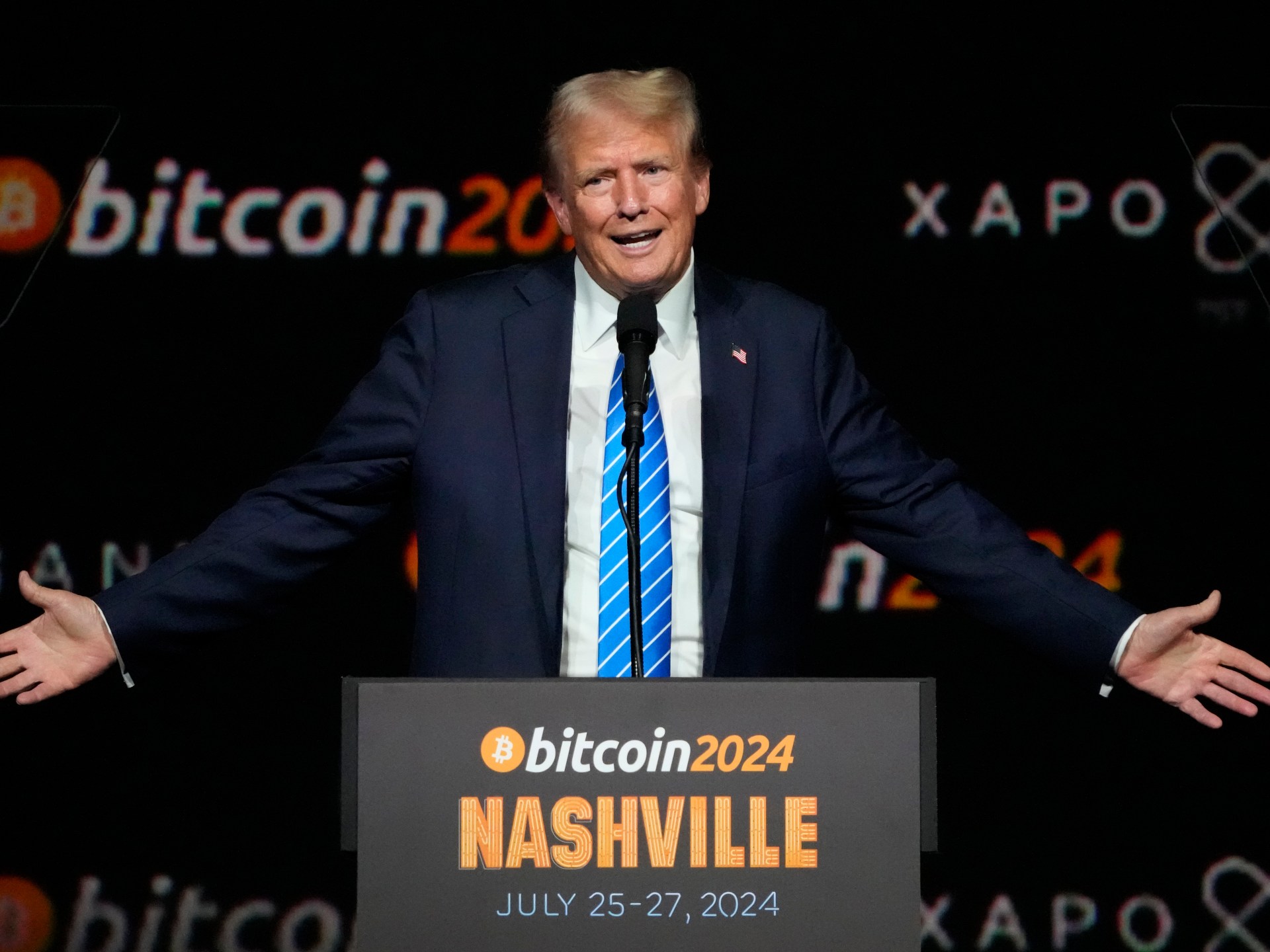
At the Bitcoin 2024 conference in July, Trump took centrestage, making a bold declaration regarding
potential future policy. Trump assured the audience that, should he regain the presidency, he would
implement measures to prevent the federal government from liquidating its Bitcoin reserves.
“If I am elected, it will be the policy of my administration, United States of America, to keep 100
percent of all the Bitcoin the US government currently holds or acquires into the future,” Trump said.
“If crypto is going to define the future, I want it to be mined, minted and made in the USA,” he added.
Mauvis Ledford, CEO of Sogni AI, a Singapore-based tech startup, says the incoming Trump administration
would likely adopt cryptocurrencies to stimulate economic growth.
“It’s plausible that Trump’s administration might explore leveraging blockchain technology to enhance
transparency and efficiency in government operations, especially with Elon Musk as an adviser. There
could also be initiatives aimed at promoting the adoption of cryptocurrencies to stimulate economic
growth and attract tech-driven investments,” Ledford, a former CTO of CoinMarketCap, told Al Jazeera.
However Ledford remains cautious about just how far Trump might go in his support for cryptocurrencies.
“I don’t personally believe anything Trump says, however, and blockchains do allow the creation of rules
that everyone must follow, which I don’t think Trump would specifically like in a government he runs,”
said Ledford.
Trump has also trained his guns at US Securities and Exchange Commission (SEC) Chairman Gary Gensler,
who has been known to be highly critical of the cryptocurrency industry.
“On day one, I will fire Gary Gensler,” Trump said at the Bitcoin conference in Nashville, Tennessee.
The SEC’s focus on crypto cases intensified in 2023, as revealed by a January 24 report from Cornerstone
Research, a litigation consulting firm. The report detailed 46 enforcement actions last year, resulting
in $281m in monetary penalties for settlements.
“We’re trying to enforce the laws at hand. … This is a field with a lot of fraudsters, a lot of
grifters, a lot of scams,” Gensler said last month during a discussion at the New York University School
of Law.
Ledford too acknowledges the many scams, which he calls “smoke and mirrors”, that have infested parts of
the cryptocurrency industry.
“The only ‘tokens’ I truly trust are Bitcoin and Ethereum. Bitcoin because it was the first creator of
blockchain technology, and a simple form of digital gold – literally all it was meant to be,” said
Ledford.
What does the surge mean for the US economy?
The recent surge could open the door for more investment into cryptocurrencies.
“Narrative drives price. The Biden administration put a choke hold on crypto. Trump, who has publicly
supported it, is seen as world, where crypto can thrive with government support. Bullish,” said Roderick
Melvin Johnson, active crypto investor since 2021.
Johnson, who is based in Clearwater, Florida, shared with Al Jazeera an important X thread from Miles
Deutscher, a prominent crypto analyst, explaining the significance of the Trump presidency and its
possible effect on the US economy.
This is the most obvious bullish setup any liquid market has had in YEARS.
That isn't an exaggeration.
I have the data to show you how the stars are aligning for the biggest crypto bull run EVER.
🧵: The only 10 important factors you need to know.👇
— Miles Deutscher (@milesdeutscher) November 11, 2024
Ledford, the Singapore-based tech CEO, notes that there has been a notable increase in institutional
investments in cryptocurrencies which should move the industry into mainstream acceptance.
“Major companies are integrating crypto payments, and advancements in blockchain technology are making
transactions more secure and efficient. Additionally, regulatory frameworks are evolving, which could
provide more stability and legitimacy to the crypto market,” he explained.
What is Bitcoin?
Created in 2009 under the pseudonym Satoshi Nakamoto, Bitcoin is a digital currency that exclusively
trades online. Using a technology called blockchain, it allows every Bitcoin transaction to be stored on
thousands of computers worldwide, known as the “public record”, making it virtually impossible to hack.
Each computer has stored every transaction that has ever been made, which is known as a node. When a new
cryptocurrency transaction happens anywhere around the word, every node gets its “public record’
updated. Due to the decentralised nature of blockchain, no one computer controls the data.
Till this day, the creator of Bitcoin is unknown.
In 2010, the first real-world purchase using Bitcoin was two pizzas bought for 10,000 Bitcoins,
approximately $41 at the time, by a programmer named Laszlo Hanyecz.
In 2021, Bitcoin’s largest transaction was the sale of a luxurious Miami, Florida mansion. The property
changed hands for a staggering $22.5m, paid entirely in cryptocurrency.