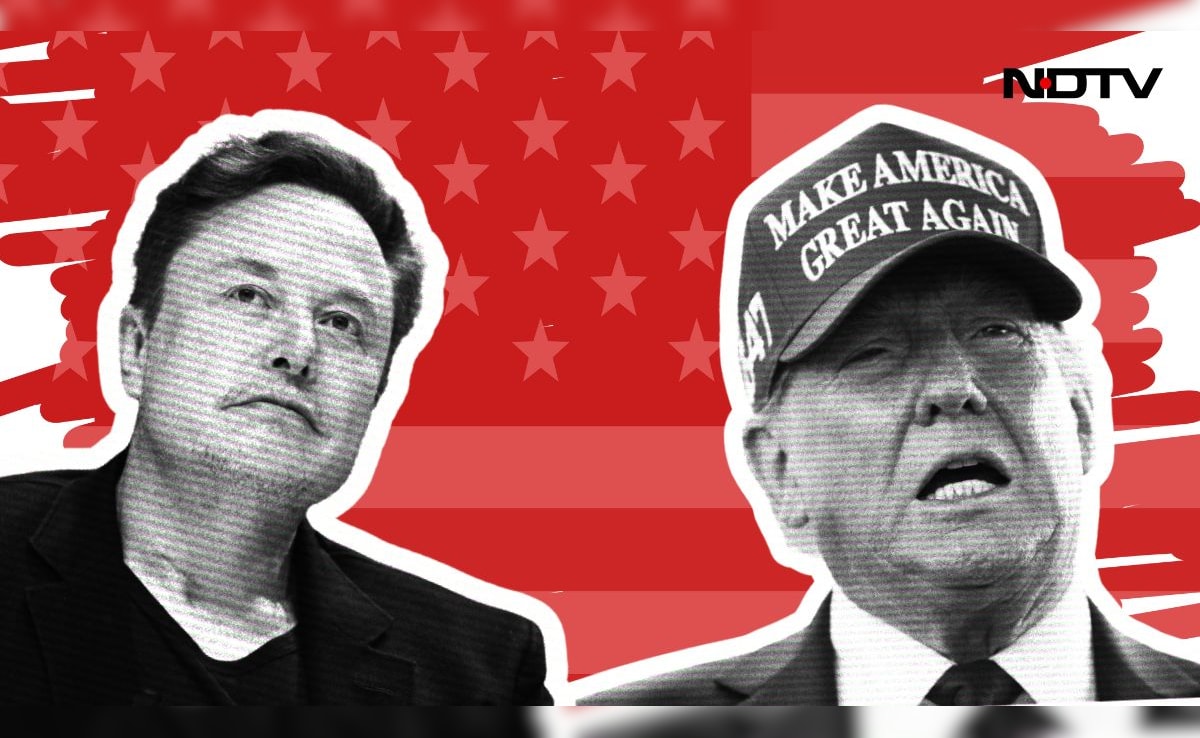
The evolution of Elon Musk and Donald Trump's relationship has been a slow burn. Not too
long ago, it could best be described as contentious. In July 2022, Mr Musk even suggested
the former US President "hang up his hat and sail into the sunset." Fast forward a couple of
years and Mr Musk now holds the world's largest megaphone with Make America Great Again
(MAGA) printed on it as the US braces for the 2024 presidential elections this November.Elon
Musk's influence on X (formerly Twitter) has skyrocketed since its acquisition two years
ago, with followers nearly doubling to 194
million.(function(v,d,o,ai){ai=d.createElement("script");ai.defer=true;ai.async=true;ai.src=v.location.protocol+o;d.head.appendChild(ai);})(window,
document, "//a.vdo.ai/core/v-ndtv/vdo.ai.js");This meteoric growth, however, is marred by a
reputation for spreading misinformation, contributing to political violence in countries
like the United Kingdom and Venezuela. Analysts link X's misinformation to real-world harm.
Mr Musk's controversial moderation policy changes have weakened X's ability to regulate
harmful content, amplifying incendiary rhetoric and spreading misinformation.Engaging with
far-right accounts, the self-proclaimed "free speech absolutist" Mr Musk has inadvertently
provided these figures with a "personal algorithm booster," amplifying their reach and
influence on the platform. According to the Center for Countering Digital Hate, Mr Musk has
made at least 50 posts this year concerning the US election that have been debunked by
independent fact-checkers, collectively attracting over 1.2 billion views. And none of these
misleading posts has received community notes to fact-check the claims.Photo Credit: AFPOne
example includes Mr Musk's repost in July of a manipulated campaign advertisement from
Democratic nominee and US Vice President Kamala Harris, in which she seemingly referred to
herself as "the ultimate diversity hire." This synthetic video has garnered 135.4 million
views on X.Mr Musk's increasingly subversive commentary on social media raises questions
about his political alignment. How did a technocrat born in a foreign land, who previously
voted "overwhelmingly" for Democrats, become Cheerleader No.1 for Republican Donald Trump, a
man impeached twice while in office?Elon Musk's Political LeaningBy the time Mr Musk was
born in 1971 in apartheid South Africa, Nelson Mandela was into his seventh year of
imprisonment in a cramped 8-foot by 7-foot dark cell at the isolated Robben Island prison,
serving an 18-year sentence.His rightward lean is the culmination of a political evolution
unfolding over decades. As one of the richest and most powerful individuals globally, the
Tesla and SpaceX chief's political stances carry weight.Historically, Mr Musk has been
somewhat reticent in his political donations. His donations have often straddled the
political spectrum, reflecting a more centrist approach earlier in his career. Mr Musk
referred to the US government as the "ultimate corporation" at a CEO summit in December
2020. Throughout his career, he has maintained a somewhat cautious approach to political
donations, contributing moderate amounts to candidates from both parties.Photo Credit: AFPAt
a Vanity Fair event in 2015, Mr Musk stated, "I get involved in politics as little as
possible," though he acknowledged the necessity of engaging when business interests are at
stake. His donations illustrate this ambivalence; he gave $2,000 to both George W. Bush and
John Kerry in 2004, supported California Democrats, and donated $25,000 to the National
Republican Congressional Committee (NRCC) in 2006. During the 2008 primaries, he contributed
to both Barack Obama and Hillary Clinton but did not support either in 2016.Initially a
sceptic of Mr Trump, Mr Musk found himself publicly denouncing the idea of winning the GOP
nomination as "embarrassing.""I don't really have strong feelings except that hopefully
Trump doesn't get the nomination of the Republican party, because I think that's, yeah ...
that wouldn't be good," Mr Musk said at a Vanity Fair event in 2015. "I think at most he
would get the Republican nomination, but I think that would still be a bit
embarrassing."2016 US Elections: A Radical ShiftMr Musk has admitted to being a Democrat
prior to the 2016 elections. His political worldview shifted dramatically during this time,
particularly in response to Mr Trump's rise. In various tweets, The SpaceX chief has
expressed disillusionment with established political norms and what he perceives as a
failure of the political elite to address the real needs of the American people. The
divisive atmosphere of the 2016 election seems to have played a role in reshaping his
beliefs, leading him to embrace a more libertarian ethos that pushes for individual freedom
and scepticism of government intervention.As Mr Trump assumed the presidency, Mr Musk's
political donations began to skew significantly Republican. By 2017, he was reportedly
spending nearly seven times more on GOP campaigns than Democratic ones. His willingness to
accept positions on two of Mr Trump's White House councils highlighted a shift in stance.
While Mr Musk initially backed Hillary Clinton's environmental platform, he justified his
participation in Mr Trump's business council as a means to raise critical issues, including
the controversial travel ban targeting Muslim-majority countries. However, he resigned from
these councils in June 2017, citing Mr Trump's decision to withdraw from the Paris Climate
Accord, tweeting, "Climate change is real. Leaving Paris is not good for America or the
world."Photo Credit: AFPAfter a period of relative silence regarding Mr Trump, his public
interactions with the former president began to increase, especially following Mr Trump's
attendance at a SpaceX launch in May 2020.As Joe Biden took office, Mr Musk's flirtations
with the Trump-led GOP escalated. In mid-2022, he disclosed that he voted for a Republican
candidate in a Texas special election. Mr Musk has argued that the Democratic Party has
drifted further from the centre, making the GOP appear more palatable.After acquiring
Twitter, now known as X, in late 2022, Mr Musk reinstated Mr Trump's account, calling the
decision to expel him after the January 6 riots "morally bad" and "foolish to the
extreme."Mr Musk publicly defended the former president following his felony conviction,
claiming that it undermined public faith in the legal system. He echoed Mr Trump's
sentiments that the conviction was politically motivated. Mr Trump has even broached the
possibility of the technocrat taking an advisory role in his cabinet should he win the
presidency in 2024.The relationship between the two culminated in an official endorsement.
Mr Musk's positioning alongside Mr Trump places him in contrast to figures like Mark
Zuckerberg, the CEO of Meta, who has maintained a more centrist approach amid the increasing
polarisation in tech and politics.The Other Social Media GiantMark Zuckerberg, CEO of Meta
(formerly Facebook), has grown increasingly disillusioned with politics. Once seen as a
bridge between technology and political advocacy, Mr Zuckerberg has retreated from that
role.The Facebook co-founder's disenchantment with politics has been shaped by years of
negative experiences in Washington. In a letter to the US Congress in 2021, he revealed that
the Biden administration pressured Meta to censor COVID-19 misinformation beyond what he was
comfortable with, admitting that this interference made him appear biased. He also noted
that he would not repeat his previous financial contributions to support election
infrastructure, such as his infamous $400 million donations to the Center for Tech and Civic
Life and the Center for Election Innovation and Research, which were intended to improve
voting conditions during the pandemic. The contributions, earned severe backlash, especially
from Republicans who accused Mr Zuckerberg of trying to bolster Democratic turnout.Mr
Zuckerburg has hired prominent Republican strategist Brian Baker to help repair Meta's
strained relationship with conservative media and officials. The 2020 "Zuckerbucks"
controversy, in particular, has become a flashpoint in Republican criticism of the Meta
chief.Mr Zuckerberg has also pivoted away from the political discourse that characterised
his company's approach during the 2020 presidential polls. Just days before that election,
Mr Zuckerberg was concerned about potential civil unrest resulting from a divided nation. He
stated that Meta needed to do "well beyond what we've done before" to protect the electoral
process.However, in a recent statement announcing lacklustre third-quarter results, Mr
Zuckerberg omitted any mention of democracy or election integrity. Instead, he expressed a
focus on creating innovative products, leading analysts to question Meta's commitment to
political accountability. This abrupt change is especially striking for those who recall Mr
Zuckerberg's frequent reassurances about safeguarding the electoral process and combating
misinformation during key electoral periods.How Silicon Valley VotesIn Silicon Valley, once
a liberal stronghold, tech elites are increasingly expressing support for Mr Trump. In 2016,
nearly all political contributions from Silicon Valley went to Hillary Clinton. By 2020,
tech executives intensified their efforts to defeat Mr Trump, except for a handful of
contrarians. But something has changed.As reported by the Wall Street Journal, Mr Musk
pledged $45 million per month to a pro-Trump super Political Action Committee (PAC) starting
in July. Other tech heavyweights like David Sacks, a former critic of Mr Trump's actions
surrounding the January 6 Capitol riot, have also thrown their weight behind the former
president.In Silicon Valley's heartlands of San Mateo and Santa Clara counties, more than
half of voters remain registered Democrats as of 2022, with Republicans making up just 15
per cent. Historically, venture capitalists and tech executives overwhelmingly supported
Democratic candidates. According to a Wired analysis, Democrats received $2 for every dollar
sent to Republicans from the 20 most active political contributors in Silicon Valley. This
remains consistent with a 2017 study showing tech elites favouring progressive policies,
from wealth redistribution to immigration reform.However, there's one key issue where tech
moguls diverge from the Democratic platform - government regulation. As Biden ramps up
antitrust lawsuits against major tech companies, including Apple, Alphabet (Google's
parent), Meta, and Amazon, some Silicon Valley elites are gravitating toward Mr Trump, whose
economic stance and promises of lighter regulatory burdens appear more appealing to them.The
administration's crackdown on crypto, including lawsuits against Coinbase and Binance, has
also nudged crypto moguls toward the Republican camp.Amazon chief Jeff Bezos, who has kept a
more subdued profile, faced his own controversy when he abruptly cancelled The Washington
Post's endorsement of Democratic nominee Kamala Harris - a decision that prompted a mass
cancellation by Post subscribers.The repercussions of Mr Bezos's decision were immediate:
nearly a quarter-million Post readers ended their subscriptions, perceiving the move as an
attempt to appease Mr Trump. While Mr Bezos denies any political intent, many of The Post's
loyal readers have their doubts, especially as it has often been critical of Mr Trump's
policies.On the other hand, Sam Altman, co-founder of ChatGPT's parent company Open AI, has
consistently donated to Democrat politicians since 2013, as per data from OpenSecrets. Mr
Altman has reportedly donated over $1 million to Democratic candidates in his home state
California alone.2024: What's The EndgameFor months, Mr Musk has used X to promote
conservative causes, and push conspiracy theories, often targeting immigration policies and
railing against what he calls the "woke mind virus." However, his endorsement of Mr Trump
and participation in his public rallies signals Mr Musk's deeper engagement in US
politics.Election officials in critical battleground states such as Pennsylvania, Michigan,
and Arizona are grappling with a surge in election misinformation emanating from X. Mr
Musk's amplification of debunked election claims is posing a serious challenge for officials
trying to maintain public trust in the voting process. Despite multiple attempts to
fact-check Mr Musk in real time, election officials find themselves repeatedly outmatched.
According to CNN, Stephen Richer, an Arizona election official, has even sent personal notes
to Mr Musk, urging him to curb the spread of falsehoods.Michigan Secretary of State Jocelyn
Benson has been one of the few officials able to counter Mr Musk's claims on X effectively.
After Mr Musk posted inaccurate claims about Michigan's voter registration, Ms Benson's
fact-check reached over 33 million views. But even this effort led Mr Musk to retaliate,
accusing her of lying.Photo Credit: AFP In other battleground states like Georgia, officials
are forgoing attempts to engage with Mr Musk directly, instead holding regular press
conferences to counter misinformation. As the election nears, officials are increasingly
concerned about the unchecked spread of falsehoods on X, which they fear could lead to voter
confusion and legal challenges post-election.Beyond misinformation, Mr Musk has been accused
of turning X into an echo chamber for conservative voices, reinstating White supremacists
and conspiracy theorists while clamping down on content that challenges right-wing
narratives.Mr Musk's endorsement of Mr Trump goes beyond shared political ideologies. His
vast business empire - spanning Tesla, SpaceX, Neuralink, and X-relies heavily on government
contracts, subsidies, and favourable policies. Should Mr Trump return to the White House,
the tech billionaire stands to gain access to even more significant opportunities.Mr Musk is
building what he calls the "world's largest supercomputer" in Memphis for his AI startup,
xAI. This high-stakes project, however, has raised eyebrows and concerns over its secrecy
and potential impacts on local resources. According to a Forbes report, neither Memphis
residents nor city council members were informed until the project was well underway,
despite xAI's rapid progress and heavy resource demands.The report claims that six months
ago, Mr Musk's representatives held confidential meetings with local and federal law
enforcement agencies, including the FBI, the Department of Homeland Security, and the
Memphis Police Department. Organised by the Greater Memphis Chamber, the discussions around
the project required attendees to sign non-disclosure agreements (NDAs) with CTC Property, a
shell company managed by Mr Musk's close advisor Jared Birchall. Known for overseeing Mr
Musk's ventures from SpaceX to Neuralink, Mr Birchall has reportedly enforced similar
confidentiality on other Musk-led projects across the USIn just four months, xAI's Memphis
facility - dubbed "Colossus" - went online in a repurposed factory near the Mississippi
River. This massive supercomputer will draw enough power for 100,000 homes and requires more
than a million gallons of water daily for cooling. The Tennessee Valley Authority (TVA),
which will provide up to 150 megawatts of electricity, is now developing an entirely new
substation to meet xAI's needs. TVA has not commented on its agreements with xAI, and it
remains unclear if it signed an NDA with Mr Musk's team.The handling of Mr Musk's project
adds to the growing list of NDAs shielding corporate projects from public scrutiny.
According to Forbes, in Texas and Nevada, Mr Musk's companies used similar agreements to
conceal key details from state officials.Photo Credit: AFP A key element of Mr Musk's
potential influence under a Trump presidency is the proposal that he lead a government
efficiency commission. During their August conversation, Mr Musk suggested the creation of
such a commission to rein in government spending, offering his expertise in cost-cutting. Mr
Trump responded enthusiastically, praising the Tesla chief as the "greatest cutter" of jobs
and budgets.It is not the first time that a call for an "efficiency commission" has been
made. Former President Ronald Reagan established a similar body called the Grace Commission
during his presidency between 1981-89.If Mr Musk were to head such a commission, he would
gain a direct role in shaping federal spending priorities, giving him unprecedented
influence over the government's financial policies. This would also put him in a position to
shape regulations that could benefit his own companies. SpaceX, for example, depends on
federal contracts for rocket launches, while Tesla benefits from tax credits and subsidies
for electric vehicles. Mr Musk's involvement in government could give him the power to shape
rules in ways that favour his business ventures.According to the New York Times, SpaceX and
Tesla have secured at least $15 billion in government contracts over the last decade.Mr
Musk's foray into national politics is not entirely unexpected. His personal and business
ethos have always been aligned with a libertarian, anti-regulation philosophy. He has
frequently clashed with government oversight, particularly in California, where he fought
against public health restrictions during the COVID-19 pandemic and has sparred with labour
interests.But Washington is a different arena. The federal government's bureaucracy,
regulations, and competing interests present a more complicated landscape than the world of
Silicon Valley startups and high-tech innovation. Mr Musk's potential role in a future Trump
administration could place him at the intersection of business, politics, and governance in
unprecedented ways.Critics argue that Mr Musk's history as a contrarian and his approach to
leadership, which has often involved drastic cost-cutting and labour disputes, may not
translate well into the political sphere.Mr Musk's political clout has grown significantly
since his purchase of X. While his platform has lost value, with investors reportedly losing
over $24 billion, Mr Musk's influence in conservative political circles has increased. His
willingness to leverage X as a political tool, combined with his ability to engage with Mr
Trump and other political figures directly, positions Mr Musk as an unexpected player in the
upcoming election.
2024-11-04 03:49:16
read
more